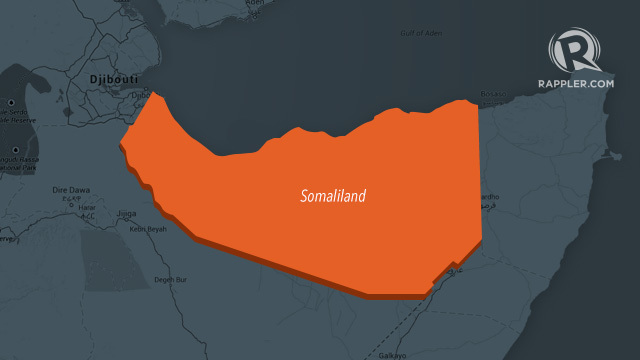
Somaliland: The World Arms Pirates While It Disarms Somaliland Navy

Medeshi 3 Oct, 2008
Somaliland: The World Arms Pirates While It Disarms Somaliland Navy
The International community’s imprudent strategy of giving millions of dollars to pirates for ransom while refusing to provide tangible trainings and equipments for Somaliland navy because of fears that such a move would tantamount to recognition has resulted triple disasters—not only for the people of Somaliland, but also for
(Photo:US helicopters and warships circling the pirates) the vessels sailing through the Gulf of Aden and for the region itself. Never before has the economic lifeline of Somaliland—exporting livestock to the Middle East—been threatened by pirates. Never before has the world seen so many hijacked ships and their crews suffering in the hands of pirates. Never before has the Golf of Aden faced environmental catastrophe. Thanks to the millions of dollars paid for ransom to free ships and their sailors. Few foreign sailors may have been set free, but the economic backbone of millions of Somaliland people as well as the safety of the Gulf of Aden face uncertainty. And the danger—environmental disasters—is growing by the minute.
It is now clear that the ransom paid to pirates is equivalent to nearly Somaliland’s yearly budget. The shipping authority, Lloyd's List, warns that “ransom paid to pirate raiders off Somalia could spiral to $50 million this year, fueling copy cat attacks.” http://webmail.skywebhosting.co.uk/webmail-n/parse.php?redirect=http%3A%2F%2Ftinyurl.com%2F3ny57z Most of this money would be spent on hiring more hijackers—they are now numbering over 1000 strong men—buying sophisticated speed boats and the state of the art weapons through the black-market. Soon pirates would be a fearless force to reckon with, in the Golf of Aden.
On the other hand, in 2007 Somaliland’s modest yearly budged was only $55 millions. Worse yet, unlike the pirates it doesn’t have millions of dollars at its disposal. Additionally, because of the U.N. arms embargo imposed on Somaliland, it cannot buy weapons to defend its territorial waters. Yet the international community continually enjoys Somaliland’s cooperation in combating “terrorism” and piracy. http://webmail.skywebhosting.co.uk/webmail-n/parse.php?redirect=http%3A%2F%2Fwww.awdalnews.com%2Fwmview.php%3FArtID%3D10613
Evidently, despite Somaliland’s meager resources, it is has launched its own anti-piracy covert military operations and apprehended pirates where a court convicted them. http://webmail.skywebhosting.co.uk/webmail-n/parse.php?redirect=http%3A%2F%2Fallafrica.com%2Fstories%2F200809090053.html And unlike the Somali Transitional Government TFG and Puntland—the epicenter of sea piracy, Somaliland is known to launch strikes against pirates and human-traffickers in its territory. (Somali Regime: Epicenter of Sea Piracy http://www.awdalnews.com/wmview.php?ArtID=10622 U.N. slams Puntland leaders for having connections with pirates http://tinyurl.com/4f7q4h ) And clearly Somaliland’s bold moves against piracy and human-trafficking explain why its coast remains safe despite sharing both land and sea borders with Puntland. But things are now changing for worse.
Currently, Somaliland navy patrols its waters, escorts ships loaded with livestock from its ports to safe areas, and meets cargo ships destined to Somaliland ports in highs seas. But pirates should by now have more boats and weapons than Somaliland navy has. Additionally, if pirates get away with it, soon their deadly arson will include 33 T-72 tanks—far more tanks than probably Somaliland has—rocket launchers and other weapons. http://webmail.skywebhosting.co.uk/webmail-n/parse.php?redirect=http%3A%2F%2Fnews.bbc.co.uk%2F2%2Fhi%2Fafrica%2F7637257.stm And this changes the whole equation.
The fast-growing number of pirates and the enormous cash at their disposal promoted Somaliland president to seek help from Europe. Alarmed or frightened by the power of pirates, recently President Dahir Riyale Kahin quickly flew to France, Germany and Britain as to shore up support for combating piracy which now threatens Somaliland’s economy and soon will choke its lifeline—exporting livestock—if immediate action is not taken.
Multinational navies increase their presence in the Golf of Aden, and so do pirates
The Europeans, Americans, Russians, Indians, and Indonesians, among others, have deployed their navies to Somalia’s waters as to fight piracy off, but to no avail. As it seems, as the number of foreign navies moving into Somalia’s sea waters increases and so does piracy. This is odd, isn’t it? But does anyone wonder why?
Like any other problem, the best approach to piracy is to study its root-cause and then cooperate with the locals. In the Somali world, piracy effects Somaliland, TFG and Puntland in different ways. While the TFG and Puntland clearly benefit from piracy and human-trafficking, Somaliland suffers because of chaos in high seas.
Clearly, Somaliland is the only authority capable of curbing piracy—provided that its navy is modernized to meet the challenges that piracy poses—but also Somaliland is the only effective government in the area. So what is the world waiting for, you may ask?
Rebuilding Somaliland Armed forces could pose a real challenge for pirates—a far more threat than multinational navies could pose. What a ludicrous claim to make, you’d think? Evidently, the International forces would rather fire few missiles from a ship or from a helicopter than fight on the ground and get their hands dirty. And the cost of maintaining hundreds of International war warships in Somalia’s volatile waters could amount to billions of dollars.
To the contrary, Somaliland holds the key to solving mayhem in high seas. For one thing, Somaliland forces require a fraction of the money that the world currently spends to battle against piracy and pays for ransom, in the Golf of Aden. For another, due to Somaliland’s indispensible expertise in the region, its people and its trains, its army would be able to launch air, ground, and naval attacks against pirates’ bases deep in Puntland and in Somalia, before pirates attack ships in the Golf of Aden. Undoubtedly, any way you look at it, rebuilding Somaliland’s armed forces is not only a cost-effect strategy to curtail piracy, but it will also bring a far better result than the multinational navy forces could deliver.
However, rarely ever do military approaches alone work without offering an alternative economic incentives to those who are involved in piracy. Just as military strategies alone failed to eradicate terrorism, and so will they fall short to prevent piracy. But reconstructing the devastated Somali fishing communities, providing local fishers training and fishing equipments, cleaning up the toxic waste dumped as well as stopping the incursions of illegal foreign fishing fleets into Somalia’s sea waters, is yet another effective tactic to minimize piracy in the region. This strategy will give the Somali pirates a reason to be decent citizens again.
Also, the world must not ignore the impending environmental disasters looming on the Golf of Aden. All it takes for the pirates is to attack a gigantic oil tanker and pierce a hole through its massive oil tank with a bullet from a machinegun.
In short, give Somaliland what it deserves and watch piracy dwindle before your eyes. The alternative is to carry on the status queue: keep Somaliland’s hands tight behind its back, pay millions of dollars to pirates for ransom, and kiss goodbye to the Golf of Aden. And surely, the closure of the Suez Canal will soon follow. The choices are clear. The world must act now.
Dalmar Kaahin

Securing Red Sea coast

Medeshi 2 Oct, 2008
When India used to secure Somalia’s Red Sea coast
And why it must do so again
The pirates of Puntland made the strategic mistake of becoming too successful. And they also ran out of luck, when among the vessels they hijacked was one carrying a huge arms shipment, and another something mysteriously important. And suddenly, the world’s navies with the capability to get there—save India’s—decided that it was time to sail to go pirate hunting (or, at the very least, pirate watching) in the Red Sea. The US navy is already there. The Russian navy is on its way (and may well demonstrate some muscle in the days ahead). Even the European Union “is setting up an anti-piracy taskforce to help protect the lawless sea lanes off east Africa.”

Now, piracy off Somalia presents both threat to humanitarian relief operations, international security and to international commerce. And both the UN security council and the president of Somalia have called for the international community to take an interest in patrolling the region. And as Seth Weinberger writes, suo motu action against pirates has legal sanction under international law.

Piracy is one of the clearest examples of jus cogens, a preemptory norm that creates a crime for which there is no possible justification and for which there is universal jurisdiction. Thus, anyone who wishes to act against the pirates is legally allowed to do so. However, that creates a problem—in the absence of a specific jurisdiction, no one has the responsibility or strong incentive to act (why should one state bear the cost of enforcement when the cost of piracy falls on many?). [Security Dilemmas]

The question, though, is how long these navies will stay in the region. While the United States and its allies have the logistics and support infrastructure in the region, other naval forces will have to work out arrangements if they are to maintain forces for an extended period of time.

Amid all this, the Indian government is demonstrating an inexplicable reluctance to dispatch the Indian navy to the waters off Somalia. Not only does this position disregard the threat to India’s interests in the region, it also ignores the fact that a century ago, it was the (British) Indian navy that used to secure the Red Sea.

During the prime mininstership of William Gladstone in the 1880s, it was decided that the Indian government should be responsible for administering the Somaliland protectorate because the Somali coast’s strategic location on the Gulf of Aden was important to India. Customs taxes helped pay for India’s patrol of Somalia’s Red Sea Coast. [David D Laitin/LOC]

According to retired Vice Admiral Arun Kumar Singh, “it is almost impossible, and prohibitively expensive, for the Indian Navy to send two warships and a tanker, some 2,000 nm from our west coast, and keep them on patrol for 365 days a year in the “safety corridor”. He argues that apart from placing armed “Sea Marshalls” on board commercial ships passing through the region, the Indian navy should partner those of the west and Russia to patrol the region.

The long-term solution, of course, lies on land: extricating Somalia from its civil war, and stabilising the entire Horn of Africa. That’s a tall order. In the meantime, it is necessary to contain the Somali pirates. There is a clear case to deploy the Indian Navy in the Red Sea off the coast of Somalia, with rules of engagement that include hot pursuit. Indeed, there is a clear case to task the marine commandos with hostage-rescue missions where Indian ships and nationals are taken hostage.

Tensions simmer in southern Yemen

Medeshi 2 Oct, 2008
Tensions simmer in southern Yemen
By Shane Bauer in Sanaa
As the Yemeni army hunts down al-Qaeda-linked groups across the country and struggles to maintain peace with a Zaydi Shia insurgency in the north, political tensions in the south are driving a new wedge into the already fractured country.
At least 17 protesters have been killed and 864 arrested since the unrest erupted in the summer of 2007, according to Yemeni human rights groups.
(Photo:Rebels in southern Yemen)
While demonstrations, riots, and armed clashes with the military seem to have intensified, demands for political reforms in the Middle East's poorest country have developed into calls for independence for the south.
Former military generals, unemployed professionals, and disgruntled youth across the south contend that the north is economically more developed and that northerners are favoured by the government in Sanaa.
"We aren't Yemenis. We are South Arabians," says Ali al-Sa'idi, the vice president of the Committee of Retired Southern Generals, referring to the historical name of South Yemen.
"We used to be an independent nation and we want to go back to what we were."
New country
The traditionalist north and Marxist south unified in 1990, forming the Republic of Yemen.
The new country was to operate under a structured power-sharing arrangement, but fraternal relations quickly disintegrated, leading the country into a two-month civil war in 1994.
After northern forces crushed a southern bid to secede, the government led by Ali Abdullah Saleh, the current president, scrapped plans to protect regional autonomy.
Thousands of generals were punitively retired after the war, and roughly 100,000 civil and military workers lost their jobs. Thousands of soldiers fled the country, but many have since returned.
Growing tensions erupted in July 2007 when former generals began organising protests to demand higher retirement funds, claiming they could not survive on their pensions.
Riots
The latest tide of protests erupted on March 28, when tanks, helicopters, and fighter jets were brought in to quell three days of riots in the southern city of Dhalie.
Young men burned tires to block the street from Sanaa to Aden and set two police stations and several military vehicles on fire.
People accused of instigating the riots were arrested and public demonstrations eased off, though protests continued in Dhalie and nearby Lahaj.
Since then, large scale demonstrations have waned, but armed attacks against the government have increased.
In mid-September, three coordinated bombings, unclaimed by any specific group, targeted Central Security and Criminal Investigation offices in the southern provinces of Abyan.
A recent report in Jane's, an American military intelligence magazine, estimated that at least 15 separate attacks have occurred against military checkpoints in Aden and the southern province of Lahaj alone.
"The situation could become much more dangerous than other problems in Yemen," says Mohammed al-Mutawakkal, a professor of politics at Sanaa University.
"The south comprises two-thirds of Yemen's land and it used to be its own country."
Al-Saidi's group of retired generals and other movements have been calling on southerners to refrain from violence. But al-Sa'idi says that if the government does not meet their needs, the situation might get out of control.
"We are living under occupation," he says. "The tribal military regime in the north does not care about Southerners. They just care about our land and wealth."
Natural wealth control
Around 80 per cent of Yemen's national budget comes from natural wealth drawn from the dry, barren expanses of the south.
Depleting reserves of natural gas and its primary export, oil, are extracted from southern deserts. The 900-kilometre coastline provides Yemen with fish, its second largest export and its largest port.
The government responded to the discontent earlier this year by raising the pensions of some former generals and giving others positions in the military.
"We made an agreement with the generals and there is a minority of people trying to take advantage of their legitimate grievances and turn it into a political situation," Abubakr al-Qurbi, the minister of Foreign Affairs, told Al Jazeera.
Ali Abdullah Saleh, the president, has remained mostly silent on the tensions in the south, but Nassr al-Shaibani, the former endowments minister, issued a fatwa calling the southern generals apostates and permitting bloodshed of those who staged sit-ins and demonstrations.
Southern journalists say they have been up against a media blackout. Yemeni and foreign reporters have been arrested for attempting to cover demonstrations.
In February, one person was killed when the Sanaa home of the editor-in-chief of Al-Ayam newspaper, Yemen's leading independent newspaper - largely perceived to be sympathetic to southern independence, was riddled with bullets.
Independence unlikely
Many observers say it is unlikely that southerners will ever achieve independence, citing the government's military dominance and the fact that south Yemen makes up less than one-fifth of the country's population.
But with some southerners edging toward violence and with popular sentiment for independence higher than ever, the situation remains deadlocked.
"The only solution to the southern issue has to be a democratic one," al-Mutawakkal said.
"The government needs to sit down with them and come up with a suitable agreement."
A presidential order to release at least a dozen leaders of southern movements during Ramadan suggested that the government might be changing its tone.
But some say it is far from negotiating a comprehensive settlement.
"If these people want to make changes, they can form a political party and try to reform the government," al-Qurbi said.
"Yemenis have worked hard to build unification. They will not allow anyone to break this country apart."

Kenya arrests maritime source over Somalia piracy

Medeshi
Kenya arrests maritime source over Somalia piracy
02/10/2008
By Celestine Achieng
MOMBASA, Kenya (Reuters) - Kenyan police said on Thursday they had arrested the head of a regional maritime group for "alarming" statements about the hijack of a Ukrainian ship off Somalia and the destination of its military cargo.
The detention of Andrew Mwangura, whose East African Seafarers' Assistance Programme monitors shipping in the region and promotes sailors' rights, heightened controversy around the seizure of the MV Faina by Somali pirates a week ago.
The pirates want $20 million to free the 20 crew members and cargo of 33 tanks, grenade-launchers and other weapons.
Mwangura angered local authorities by saying the weaponry, which was en route to Mombasa, was ultimately bound for South Sudan and not Kenya as Nairobi insists. That has embarrassed Kenya which brokered an end to Sudan's north-south war in 2005.
"Mwangura is in our custody and he will be appearing in court ... to be charged with using alarming statements," Mombasa chief detective Amos Tebeny said.
Mwangura was picked up by police and taken away in a convoy of six vehicles on Wednesday night from the offices of local Standard newspaper where he was due to give an interview.
He is expected to appear in court on Thursday or Friday.
About 50 heavily-armed pirates are holding the Faina offshore near Hobyo village. Several U.S. navy ships are watching it, and a Russian ship is approaching too.
The saga has highlighted rampant piracy off Somalia in the strategic Gulf of Aden and Indian Ocean ship lanes.
COSTLY ATTACKS
Ransom negotiations are going on via satellite phone, maritime officials say. But with the international community increasingly angry over the disruption to trade, shippers are calling for tougher action against the pirates.
Taking advantage of chaos onshore, where an Islamist-led insurgency is raging, Somali pirates have attacked scores of boats this year and are still holding about a dozen.
British think-tank Chatham House said on Thursday piracy had cost shippers between $18-30 million in ransoms so far in 2008.
Mwangura says his information comes from families of pirates and crew, plus shipping groups round the region and beyond. But Kenyan officials say he has fallen for pirates' propaganda.
"The information that my client has been receiving has been coming from officials of the same union (seafarers programme) both in Ukraine and Russia," said his lawyer, Francis Kadima.
"My client has a right to free expression."
The U.S. navy said this week that it believed the arms were for South Sudan, and many Kenyans share that suspicion.

Leading local paper Daily Nation, quoting "impeccable sources in Kenya's military" said its investigations had shown Sudan was the probable destination.

Analysts say Kenya has traditionally bought such equipment from the West, so sourcing in Ukraine would be unusual.

Civil groups are starting to agitate. The Kenya National Youth Convention condemned "the reckless and dangerous conduct of national affairs by elements within the Government of Kenya and calls for an end to the importation of offensive weaponry."

(Additional reporting by Andrew Cawthorne in Nairobi; Writing by Andrew Cawthorne; Editing by Matthew Tostevin)

Somalia warlord government courts Russia

Somalia warlord government courts Russia
Medeshi 2008-10-02 - Western backers of current imposed parachute government for Somalia were suddenly made redundant and their influence over heinous warlords left in tatters.

Somalia's ailing government struck a unilateral deal with Russia rendering western naval ships and future plans for Africom useless in an effort to free one hijacked Ukrainian ship carrying thirty odd tanks to the Ethiopian military.
Current "Transitional Federal Government" for Somalia enjoyed unconditional support riding USA waves of "war on terror" and its pogroms. In return, western allies enjoyed complete

control of air, sea, and food securities in the now defunct former Somali Republic. America bombed at will, slaughtered at will and still continues to arrest and detain Somalis at will even in their homeland.
Despite warnings from security experts in American circles such as J Peter Pham of University of Virginia once warned of "Russian bear's return to Africa". Russia's political surge coupled with the increased intensity to seek foreign collaborations might have been dismissed by NATO, but is now a reality in parts of Africa.
Speaking to sympathetic local media from the tribal fiefdom of Majertenia, the president of "Transitional Federal Government" for Somalia commented discouragingly on the illusive "Islamic extremism" than the current terror which his fiefdom has unleashed on the seas.
Russia's new deal to use force in Somalia just as its western counter parts had done so will be difficult to assume. However, if lessons are learnt from past Russian interventions in releasing hostages; it will be a bloody attempt.
More daringly, "Transitional Federal Government" for Somalia's appointment ambassador to Russia suggested his government's will to recognise the new states of Abkhazia and South Ossetia after deservingly escaping from the clutches of the crippled infantile Georgia. South Ossetia and Abkhazia remain isolated by the rest of the world except Russia who shows interest in their rights to survival.
Ambassador Handule, a reader of Russian arts and culture is a prominent member of Somali intellectuals united in finding alternative solutions to Somalia crisis than current myopic state of affairs giving precedence to warlords over the long suffering civilian population.
Exactly what the skeleton ghost country of former Somali Democratic Republic would add to Abkhazia and South Ossetia is unclear, but the warlords intensions to juxtapose its sponsors may begin from here just as many Somalis lost faith with the west pushing them to extreme forms of anti-America affiliations.
Author:Shuun Isaaq
PRI-Inside

Somalia asks Russia for help with pirates

Medeshi 2 Oct, 2008
Somalia asks Russia for help with pirates
Story Highlights
NEW: Somalia wants Russian warships to intervene; Russia rules out using force
Pirates captured Ukrainian MV Faina, loaded with weapons, off Somalia's coast
Officials fear weapons will get into terrorists' hands
Ships from 10 countries, including U.S., in region; Somalia fed up with inaction

MOSCOW, Russia (CNN) -- The Somali government has asked Russia to intervene against pirates who have seized a Ukrainian cargo ship, the Somali ambassador to Russia said Wednesday.
But the Russian navy issued a statement later in the day saying it had no intention of using force against the pirates, the Russian news agency Interfax reported.
"The questions of freeing the ships and crew are being dealt with in line with the corresponding international practices," Interfax quoted Navy spokesman Igor Dygalo as saying. "For understandable reasons, the use of force would be an extreme measure because it could threaten the life of the international crew of the ship."
The pirates took over the MV Faina last week off the coast of Somalia and are demanding a $20 million ransom for the ship's cargo of 33 Soviet-made T-72 tanks, tank artillery shells, grenade launchers and small arms. The ship is anchored within Somalia's 12-mile territorial limit.
"The government and the president of Somalia are allowing the Russian naval ships to enter our waters, and fight against pirates both in the sea and on the land, that is, if they would have to chase them," Amb. Mohamed Handule said at a news conference in Moscow.
"We think that this issue of piracy has exceeded all limits. It is very dangerous that pirates are now laying their hands on arms -- not just for Somalia, not only for the navigating, but for the entire region in general," he added. "Right now, pirates are controlling the sea in this area, but just imagine if they get control of the land too."
The announcement raised concern among some officials monitoring the situation. Watch Russian warships move to confront pirates »
"We may have bad news," said Andrew Mwangura of the Kenya Seafarers Association.
Mwangura said some of the Ukrainian crew's family members are concerned for their loved ones' safety and have called him to see if he can communicate with the pirates. He urged negotiations to continue.
"For the safety of the crew members," Mwangura said, "let the ship owners talk with the pirates." Watch Mwangura talk about the rise in pirating »
A Russian navy ship sailing toward the Faina is in the Atlantic Ocean and "still has a bit of water to get here," said U.S. Navy Lt. Stephanie Murdock, who is stationed in nearby Bahrain. "There is no estimated time of arrival yet."
The U.S. Navy has several ships in the area monitoring the situation.
"There have been no changes today," Murdock said.
The Navy has not communicated with the Russian ship but will work out coordination when it arrives, Murdock said.
The Russian ship Neustrashimy is headed to the region solely to protect Russian shipping, according to the Russian navy spokesman.
"The navy command has been stressing that the Neustrashimy, from the Baltic Sea Fleet, has been given the task of arriving in the area of Somalia and guaranteeing for a certain time the safe seafaring of Russian ships in the area with a high risk of pirate attacks. The essence of the mission is to prevent the seizure of Russian ships by pirates," Dygalo said.
Handule, the Nigerian ambassador, seemed to criticize the United States for not taking action.
"Ships of more than 10 countries are now close to our shores, but we are not satisfied with the results of their activities," he said.
Citing U.N. Security Council Resolution 1816, Handule said, "We are inviting all countries, all states who have possibility to support Somalia to fight against ... pirates. We are especially inviting Russia and giving special status to Russian warships to fight, to help Somalia."
The latest developments came two days after three pirates were killed when they started shooting at each other, according to Mwangura, the Kenya maritime official. The shootout centered on a disagreement between moderate and radical pirates aboard the ship, Mwangura said. The moderates wanted to surrender, but the radicals did not.
The pirates hijacked the ship off the coast of Somalia September 25. The Faina had been headed to the Kenyan port of Mombasa after departing from Nikolayev, Ukraine, and was seized not far from its destination.
The Faina is owned and operated by Kaalbye Shipping Ukraine, and its crew includes citizens of Ukraine, Russia and Latvia, the Navy said.
Abdi Salan Khalif, commissioner of the coastal town of Harardhere, told CNN the pirates told a group of town elders that one crew member had died of high blood pressure problems.
Attacks by pirates have increased dramatically in the waters off Somalia's northern coast in the past year, prompting the U.S. and other coalition warships to widen their patrols in the region.
Three ships were hijacked on August 21 in that area, the "worst number of attacks" in a single day in many years, Capt. Pottengal Mukudan of the International Maritime Bureau told CNN.
After the spate of attacks, the U.S. Navy's Fifth Fleet in Bahrain announced that it would begin patrolling a newly established shipping corridor in the Gulf of Aden in an attempt to protect international shipping. Canada also sent a warship through the end of September.
The International Maritime Bureau said in April that 49 pirate attacks on ships were reported in the first three months of 2008, compared with 41 for the same period last year. It recorded 263 pirates attacks last year, up from 239 the year before and the first increase in three years.
All AboutU.S. NavySomaliaRussia

Fake Terror War Intensifies in Somalia

Medeshi 2 Oct, 2008
Bipartisan Terror War Intensifies in Somalia
Written by Chris Floyd
Thursday, 02 October 2008
Silent Surge: Bipartisan Terror War Intensifies in Somalia by Chris Floyd
( Photo : Man starving to death in the Somali region)
In the recent presidential "debate," both candidates expressed their eager, unstinting, even feverish support for the so-called "War on Terror" being waged by Washington and its proxies around the world.
Indeed, throughout the entire campaign, Barack Obama and John McCain have repeatedly pledged their fealty to the Terror War, and all that it entails: an even larger war machine (with even more public boodle for war profiteers); a continued military presence in Iraq (under one guise or another); a substantial expansion of the hate-fomenting war in Afghanistan (with a concomitant raise in "collateral damage"); an extension of that war into Pakistan (destabilizing and radicalizing a fractious state with a nuclear arsenal); pressing ever closer to the threshold of war with Iran (with bellicose threats, blockades and demonizing propaganda); establishing even more military satrapies to exercise dominion over the regions of the earth (including new proconsular commands for Africa and the United States itself); and -- as we have noted here over and over -- the bloody rendering of Somalia into a boiling, hellish cauldron of slaughter, suffering and chaos.
Somalia is the invisible third front of the Terror War, an American-backed "regime change" operation launched by the invading army of Ethiopia and local warlords in December 2006. In addition to helping arm, fund and train the army of the Ethiopian dictatorship, the United States has intervened directly into the conflict, carrying out bombing raids on fleeing refugees and nomads, firing missiles into villages, sending in death squads to clean up after covert operations, and, as we reported here long ago, assisting in the "rendition" of refugees, including American citizens, into the hands of Ethiopia's notorious torturers. [See note below for more links.]


[For complete article reference links, please see original here.]


"The soul of a nation is under the knife...." -- Bob Dylan

Together, the American Terror Warriors, the Ethiopians and the warlords (some of them directly in the pay of the CIA) have created the worst humanitarian disaster on earth. Thousands have been killed in the fighting. Hundreds of thousands have been driven from their homes, many fleeing to northern Kenya, where more than 215,000 people are languishing in a single refugee camp in Dadaab; 45,000 people have poured into the camp this year alone, says the UN. In some of the camps, Somali refugees are living without any shelter at all: "The BBC's Mark Doyle, who has recently visited the camps in Kenya, says some refugees do not even have a basic plastic sheet to protect them from the sun and rain."
In just the last two weeks, more than 18,500 people have fled the capital of Mogadishu, which has already been decimated by the warfare. Many were sent on the run by one of the Ethiopians' favorite tactics: mortar and artillery fire into civilian areas believed "sympathetic" to the insurgents.
The United States is not only backing the Ethiopians and the Somali transitional government (TGF) propped up by the occupation; Washington has also provided "robust financial and logistical support to armed paramilitaries resisting the command and control of the TGF," according to a major new study of the conflict by the human rights organization, Enough. In addition to these freebooters, it turns out that the wide-ranging Somali pirates -- who last week hijacked a shipload of heavy weapons being funneled into African conflicts by Ukrainian war profiteers -- are supported by "backers linked to the Western-backed government" in Mogadishu.
In other words, the United States is sponsoring a hydra-headed conflict that spews fire and destruction in every direction, and is trampling an already ravaged people deeper into the dirt. It is by any measure -- even the mass-murdering standards of our day -- a sickening abomination, a war crime of staggering proportions. Yet it goes on, day after day, without the slightest comment, much less criticism, from the entire bipartisan political establishment, and almost all of the media -- including most of the "dissident" blogosphere. The Somalis are simply non-people, a nation of ghosts, unseen and unseeable.
II.
An exception to the media's "cloud of unknowing" around Somalia appeared this week in Salon.com, where Jennifer Daskal put a human face on a single aspect of the Terror War atrocity: rendition. From a refugee camp in Kenya, she writes:
Ishmael, a 37-year-old shepherd from the Ogaden region in Ethiopia, looked at me with tears in his eyes. Ethiopian forces -- who had already killed his mother, father, brothers and sisters -- murdered his wife days after they were married. They then slaughtered his goats, beat him unconscious, and slashed his shoulder to the bone, he said.
In December 2006, Ishmael crossed through Somalia into Kenya, heading for the nearest refugee camp in search of medical care. But when he didn't have enough money to pay a 1,000 shilling ($15) bribe, the Kenyan police bundled him into a car and took him to Nairobi. Less than a month later, he was herded onto an airplane with some 30 others, flown to Somalia and handed over to the Ethiopian military -- the same forces that he previously fled.
Ishmael is a victim of a 2007 rendition program in the Horn of Africa, involving Ethiopia, Kenya, Somalia and the United States. There are at least 90 more victims like him. Most have since been sent home. A few -- including a Canadian and nine who assert Kenyan nationality -- remain in detention even now. The whereabouts of 22 others -- including several Somalis, Ethiopian Ogadenis, and Eritreans -- remain unknown....
[In the immediate aftermath of the invasion], Kenyan authorities arrested at least 150 men, women and children from more than 18 countries -- including the United States, the United Kingdom and Canada -- in operations near the Somali border, and held them for weeks without charge in Nairobi. In January and February 2007, the Kenyan government then unlawfully put dozens of these individuals -- with no notice to families, lawyers or the detainees themselves -- on flights to Somalia, where they were handed over to the Ethiopian military. Ethiopian forces also arrested an unknown number of people in Somalia....
An unknown number of them -- likely dozens -- were questioned by the Central Intelligence Agency and Federal Bureau of Investigation agents in Addis Ababa. From February to May 2007, Ethiopian security officers daily transported detainees -- including several pregnant women -- to a villa where U.S. officials interrogated them about suspected terrorist links. At night the Ethiopian officers returned the detainees to their cells....
In addition to working with the U.S., the Ethiopians used the rendition program for their own ends. For years, the Ethiopian military has been trying to quell domestic Ogadeni and Oromo insurgencies that receive support from neighboring countries, such as Ethiopia's archrival, Eritrea. The multinational rendition program provided them a convenient means to continue this internal battle -- and get their hands, with U.S. and Kenyan support, on those with suspected insurgent links.
Ishmael was one of their victims.
The questions his Ethiopian interrogators asked were nonstop, and always the same: "Are you al-Qaida? Are you an Ogadeni rebel? Are you part of the Somali insurgency?" Each time he said no, he was beaten, sometimes to the point of unconsciousness. When he resisted answering, they targeted his testicles.
Then, in February 2008 -- some 14 months after his original arrest -- the Ethiopians decided Ishmael was no longer worth the trouble. They dumped him, along with 27 others, just over the Somali border....Now Ishmael is back in the refugee camp, limping and urinating blood. He is still waiting for the healthcare he came searching for nearly two years ago.
Deskal's story is marred by the same timidity with which groups like Human Rights Watch (where she serves as senior counterrorism counsel) general take when discussing American direction of and complicity in war crimes. These references are often couched in terms of "a perception" (or even misperceptions!) of American intentions. The latter are always given the benefit of doubt and qualification. Still, it requires little reading between the lines to see the confirmation of what every honest observer of the conflict can see: the Terror War operation is creating more of the violent extremism that it purports to combat:
Almost everyone I spoke with assumed -- whether true or not -- that the United States backed the arbitrary arrest and unlawful rendition of men like Ishmael and the still-detained Kenyans. Almost everyone assumed that the Ethiopians operate with America's blessing.


‘Famished’ Canadian held in Ethiopia

Medeshi 2 Oct, 2008
‘Famished’ Canadian held in Ethiopia
A Canadian awaiting trial on terrorism-related charges in Ethiopia was described as injured and malnourished in a human rights report released yesterday.
Human Rights Watch said it had interviewed a former detainee who saw former Toronto resident Bashir Makhtal in a prison in the Ethiopian capital Addis Ababa.
“He was limping. He had a deep cut in one of his legs. He looked weak. He looked so famished,” the report quoted the unidentified witness as saying during an interview conducted at a refugee camp.
The report did not directly accuse Ethiopia of mistreating Mr. Makhtal but it did say that detainees like him have been subjected to “brutal beatings and torture.” It also quoted a man who was detained with Mr. Makhtal as saying that Ethiopian interrogators had repeatedly asked, “Are you al-Qaeda” and beaten him when he said no.
He was arrested in December, 2006, as he was crossing from Somalia into Kenya. He was secretly flown to Mogadishu, Somalia, where he was handed over to Ethiopian officials who brought him to Addis Ababa.
At the time, Islamist militants in Somali were fleeing toward Kenya to escape U. S.-backed Ethiopian and Somali troops. The Canadian government has claimed that some of the Islamists fighting in Somalia were actually Canadians.
Mr. Makhtal immigrated to Toronto from Ethiopia and is the grandson of the founder of the Ogaden National Liberation Front, an Ethiopian guerrilla group, but his family says he was only selling used clothing in Somalia.
The New York-based human rights group yesterday released a report, titled “Why Am I Still Here?” that named Mr. Makhtal as one of 10 who were sent to Ethiopia as part of a rendition program and who remain in detention there.
The report said several of the men were interrogated by American officials in the Ethiopian capital soon after they were transferred there from Kenya and Somalia. Others remain unaccounted for, it said.
Mr. Makhtal was placed in solitary confinement, the report said. He could face the death penalty if convicted at his upcoming military trial.
Canadian officials visited Mr. Makhtal in July, 2008. Ethiopia has assured Canada he will have a lawyer at his trial.
The report called on the Canadian government to ask Ethiopia either to prosecute Mr. Makhtal in a civilian court that meets international standards or release him and return him to Canada. The Department of Foreign Affairs had no comment yesterday.

Another Guantanamo in Ethiopia

Medeshi 2 Oct , 2008
Group says Ethiopia won't release terror suspects
By ANITA POWELL –
NAIROBI, Kenya (AP) — Suspects arrested in a clandestine anti-terrorism sweep in East Africa nearly two years ago have been abandoned by their governments, a human rights group said in a report released Wednesday that also detailed torture accusations from former prisoners.
One Canadian and nine Kenyans are still jailed without charge in Ethiopia after being arrested in 2007 and 22 more east Africans of various nationalities are missing, said a report by Human Rights Watch titled "Why Am I Still Here?"
The men were part of roundup of about 90 people arrested in the months after Ethiopia toppled Somalia's Islamist government at the end of 2006. They are accused of being members of insurgent and Islamist groups such as al-Qaida.
The prisoners were detained in Kenya, Somalia and Ethiopia and moved to secret jails where some say they were tortured by Ethiopian guards and often questioned by American interrogators, the report said.
Ethiopia is a key ally in America's war on terror, but is frequently criticized for its poor record on human rights and the suppression of political opposition.
The American government has previously acknowledged questioning foreign terror suspects transferred from other countries to Ethiopian jails, but denied there is anything illegal about the practice. American officials said the suspects were never in American custody.
"No one has any interest in (the prisoners), and they seem to be stuck in never-never land," said the report's author, Jennifer Daskal, a senior counterterrorism counsel for the New York-based Human Rights Watch.
"Those governments involved — Ethiopia, Kenya and the U.S. — need to reverse course, renounce unlawful renditions, and account for the missing," she said.
The group said it conducted interviews with 12 former and current detainees and numerous other sources. Some detainees gave harrowing accounts of being tortured by their Ethiopian captors, including being knifed and having toenails pulled out, the organization said.
Several men said they had been beaten repeatedly, suffered permanent injury and disfigurement, only to be suddenly released after months of interrogation and dumped penniless in Somalia, Human Rights Watch said.
"All the other foreigners we were held with here have been released. No one cares about us. Please help us," Salim Awadh Salim, a 36-year-old Kenyan, said to Human Rights Watch by telephone from prison.
"The Kenyan government has refused to acknowledge their Kenyan citizenship and bring them back home," Daskal said.
Kenyan officials were not immediately available for comment on Tuesday, a public holiday in Kenya.
Ethiopian officials have previously acknowledged holding detainees, both foreign and Ethiopian, without charge or contact with their embassies. In April 2007, Ethiopia's Foreign Ministry acknowledged holding 41 suspects and ordered their release.
Wednesday's report also says Ethiopia secretly arrested Ethiopian men accused of being members of internal rebel groups, such as the separatist movements the Oromo Liberation Front and the Ogaden National Liberation Front.
Ethiopian officials were unavailable for comment Tuesday because of a public holiday in Ethiopia as well.
The report's authors say that the roundup, intended to diminish terrorist threats in the region, has only increased them.
"This horrific experience ... does nothing but breed resentment both against the countries directly involved — Ethiopia and Kenya — and the U.S.," Daskal said. "This type of activity merely fuels the anti-American militancy."
Associated Press Writer Elizabeth A. Kennedy contributed to this report.

War is Boring: Somalia Shows Danger of U.S. Prioritizing Ideology Over Security

Medeshi
War is Boring: Somalia Shows Danger of U.S. Prioritizing Ideology Over Security
David Axe Bio 01 Oct 2008 World Politics Review
Editor's Note: This is the first installment of a new biweekly column by World Politics Review Contributing Editor David Axe. Axe is an independent correspondent who has covered conflicts from Somalia to Afghanistan to East Timor. The column shares its name with David's blog, which is at WarIsBoring.com.
(Photo: A Ugandan member of the African Union peacekeeping force in Somalia)
On a morning late last November in Mogadishu, Somalia, a tall, toothy 65-year-old man climbed into his beat-up sedan parked in the makeshift squatter's camp he called home. Ali Mohamed Siyad, chairman of the central Bakara Market -- once the economic engine of Mogadishu, but now a mostly ruined battleground -- motored across town to my hotel for an interview.
Passing the accumulated debris of years of warfare, Siyad -- know to his friends as "Ali Dere" ("Tall Ali") -- perhaps reflected on how far he'd fallen.
Ali Dere would never use the word to describe himself, but for several years beginning in the 1990s, he was one of the city's powerful warlords, driven into the position by the looting that wracked Mogadishu in the wake of the 1991 civil war. With an arsenal of nearly 2,000 assault rifles, readily available on the black market, Ali Dere raised a security force big enough to patrol all of Bakara Market. To pay his troops, he imposed a small tax on businesses. Soon he had the armed force necessary to ward off looters. For a while, Bakara -- indeed, much of Mogadishu -- was safe, as warlords established a stable balance of power.
Contrast that to today. Mortar duels between Islamic insurgents and African Union peacekeepers in the last week have killed scores of civilians in Mogadishu. Attacks have shut down the international airport for the first time in years. Two foreign journalists and their Somali colleague were abducted at gunpoint in August and reportedly are being held somewhere in Bakara. Last weekend more than 100,000 refugees choked the roads heading out of town.
In just the last few weeks, Mogadishu, one of the world's most desperate cities in one of the world's most desperate countries, has somehow managed to become even more dangerous.
It wasn't always like this. Two years ago, Mogadishu, and much of Somalia, were under the strict but fairly orderly rule of the Union of Islamic Courts, in alliance with a number of warlords, including Ali Dere. After years of financial drought, foreign investment poured in.
Then in 2006, a confederation of northern clans calling itself the Transitional Federal Government (TFG) teamed up with the Ethiopian army and, with significant U.S. backing, destroyed the Islamic Courts in Mogadishu, disarmed the warlords and sparked the present insurgency. In Somalia, as in Iraq, the logic of waging war on any political movement that remotely resembles Islamic extremism has resulted in greater extremism.
But it didn't have to be this way. A more reasonable U.S. strategy in such places would be to engage hardline regimes. The alternative -- chaos -- is far worse.

In Mogadishu, the consequences of Washington's refusal to engage with admittedly unsavory local and regional leaders are manifest in Ali Dere's tragic fall.
His power, and his association with the Islamic Courts, made him a target of the U.S.- and Ethiopian-backed TFG. When Mogadishu fell to the TFG and Ethiopians in early 2007, Ali Dere was ordered to surrender his arms. He did so, but suspicions lingered that he was sympathetic to the Islamic Courts and the associated Al-Shabab insurgent group. The suspicions were exacerbated by Ali Dere's vocal opposition to ongoing U.S. military strikes on suspected Islamists in Somalia. (The strikes reportedly have resulted in many civilian casualties.) "I know I might be arrested," Ali Dere said when he reached my hotel that day last November, "but I don't care."
Sure enough, just a month after leaving Somalia the following December, I got an email saying Ali Dere had been arrested by government troops. I expected never to hear from him again. The transitional government's "justice" system doesn't dole out much justice, just torture and -- if you believe the rumors -- summary execution.
Had Ali Dere died, it would have been the logical result of outsiders' illogical decision to remove the only powers capable of maintaining order in a troubled city. Mogadishu's warlords had, alongside the Islamic Courts, enforced a measure of security that facilitated investment and commerce. Granted, it was security at the cost of democracy, along with many other liberties that Westerners take for granted. Cinemas, for example, were banned. But that was a small price to pay for peace.
In fact, though, Ali Dere survived. He reappeared in Mogadishu after a few weeks, explaining his arrest as a simple misunderstanding over property ownership. But I for one was skeptical. His detention coincided with reports that the TFG and Ethiopia were trying to clear out insurgents and their sponsors from their Bakara hideouts. And in a follow-up interview, the former Bakara warlord seemed a shadow of his former self. Which led me to believe that Ali Dere was squeezed for information.
Regardless, the TFG's and Ethiopia's Bakara offensive was a failure, and today Mogadishu is more violent than ever. The anti-Islamist, anti-warlord strategy in Somalia has failed, and similar approaches elsewhere in the so-called "war on terror" will also fail, as long as Washington prioritizes ideology over security in troubled countries.
To craft lasting peace, we must engage regional regimes and even local strongmen who might offend our Western sensibilities, but who are capable of enforcing a measure of law and order. We could start by giving Ali Dere back his guns.

Somalia to recognize Abkhazia, S.Ossetia - envoy

Medeshi
MOSCOW, October 1 (RIA Novosti) - Somalia will soon recognize the independence of South Ossetia and Abkhazia, the two Georgian breakaway regions recently recognized by Russia, the Somali ambassador to Moscow said on Wednesday.
So far only Nicaragua has joined Russia in recognizing the two republics. Moscow said recognition was a necessary step to protect the republics after last month's conflict.
"The government of Somalia will be preparing documents as swiftly as possible on the establishment of diplomatic relations with South Ossetia, as well with Georgia and Abkhazia," Mohamed Handule said.
Recognition of a state is a pre-requisite to the establishment of diplomatic relations.
Russia recognized South Ossetia and Abkhazia as independent states on August 26 after a brief war with Georgia, which attacked South Ossetia to bring it back under central control on August 8.
Belarus and Venezuela have signaled support for Russia's recognition of the republics, but have not yet followed suit.
Handule also said Somalia, which enjoyed the former Soviet Union's backing in the 1970s when it was proclaimed a socialist state, hopes to launch military and technical cooperation with Russia.
"We want Russia to start military and technical cooperation with our country as soon as possible. Active talks are currently underway between our countries' foreign ministries on Russia's assistance in training Somali border guards, combat units, and security services," he said, adding that he hoped the Russian Defense Ministry would soon engage in talks.
Somalia has been without an effective central government since President Siad Barre was overthrown in 1991. The country, which emerged as an independent state comprising a former British protectorate and an Italian colony in 1960, has for years been plagued by territorial and religious disputes. It has struggled to cope with famine and disease that have had a heavy death toll.
Earlier on Wednesday, the diplomat said Somali President Abdullahi Yusuf Ahmed has allowed Russia's military to fight pirates off Somalia's coast and on land.

ETHIOPIA: Sheepish Address to the UN General Assembly by the Foreign Minister


Medeshi 01 Oct, 2008

ETHIOPIA: Sheepish Address to the UN General Assembly by the Foreign Minister

Sophia Tesfamariam
(Photo : weeping Somali women and her children denied food by the Ethiopian regime)
The news headlines have focused on the US financial crisis and the corrupt business practices that are now going to cost the American taxpayers billion of dollars as the federal government contemplates bail outs for the various financial institutions that are on the verge of collapse and just this week, there were hearing on Capitol Hill about the corruption, mismanagement and waste of billions of our taxpayers monies in the war in Iraq. Unemployment is at its highest and Americans are loosing their homes to foreclosures, and the US economy is screeching to a halt, with no bail out agreement on hand. Sheela Baath reporting for the Wall Street journal wrote on 30 September 2008 that:
"…Wall Street will never forget Monday, September 29, when the lords of high finance were rudely reminded that it isn't easy to get away with imprudent investments, no matter which Ivy League degree they possess…The bailout plan was nixed not only because the figure of the financial assistance -- $700 billion -- was almost pulled out of thin air without solid basis, but also because the American taxpayer was supposed to fund it. The anger that bubbled over and poured onto the streets in the form of protests and demonstrations across the United States was one of the main reasons why the plan was vetoed…"
As if that were not enough pressure on the US economy, begging bowl in hand, Meles Zenawi, the street smart deceptive Prime Minister of Ethiopia and Seyoum Mesfin, the shameless Foreign Minister, are back in town, seeking to fleece US and European taxpayers. The duo is back and lining up, once again, for a bail out. Looks like the mercenary minority regime is stuck…stuck and can´t get out that is-from its self created quagmires in Ethiopia and Somalia. It is no secret that the two are in the US-as its "staunch ally on the US global war on terror" to "threaten to leave Somalia" with the hopes of getting more funds for their mercenary agenda and also kill the recently introduced Senate Bill which is critical of the regime´s human rights record. For today, I will concentrate on the UN general Assembly and Seyoum Mesfin´s sheepish address to that world body.
I listened as the ignominious Seyoum Mesfin as he addressed the UN General Assembly on 29 September 2008 and actually felt sorry for the man. After lying to the UN body for over 10 years on the Eritrea Ethiopia border issue, lying about how and why his regime invaded and occupied Somalia, lying about the gross human rights violations being committed by his regime´s forces in Ethiopia and in Somalia, lying about Ethiopia´s respect for international law and respecting the UN and African Union Charters, he actually had nothing substantive to say. After boasting about the "Ethiopian Millennium", and Ethiopia´s "growing economy, his speech turned to the art perfected by his regime-the art of beggary. Well, let me go through his speech and highlight the many ways he did that.
Neglecting the fact that his regime has contributed to the corruption that has mired Wall Street and this US Administration, forgetting that it is the duplicity and hypocrisy of the international community in upholding the rule of law and enforcing international agreements that has contributed to the lack of confidence in the international system, Seyoum Mesfin said:
"…We call on developed countries to honour their commitment to devote zero point seven per cent (0.7%) of their GDP to Overseas Development Assistance…"
Now ain´t that some ---t?
First of all, Seyoum Mesfin does not have the moral authority to lecture the UN General Assembly (UN GA) about honoring commitments. The UN GA knows that the minority regime in Ethiopia has reneged on its legal and moral obligations under the Algiers Agreements it willingly and consciously signed. The UN GA is well aware of Ethiopia´s numerous violations of the UN Charter and international law. Secondly, neither Seyoum Mesfin, nor the mercenary minority regime can claim neglect from the international community as being Ethiopia´s "development emergency" and Ethiopia´s inability to achieve the Millennium Development Goals (MDGs).
He ought to know that regardless of how much taxpayers in developing countries put up for Overseas Development Assistance (ODA), when it comes to Africa, almost all of it will inevitably be sent to Ethiopia, the proud recipient of 80% of all aid that comes to Africa. Unfortunately, the Ethiopian people have not benefited from over 100 years of aid to Ethiopia. But for the record, let us see how much the mercenary minority regime received in just 2007 from various donors.
On August 2007 the notice from the US Embassy in Addis Ababa said:
"…United States Ambassador Donald Yamamoto announced that the U.S. is providing US $18.7 million (169 million birr) in humanitarian assistance for needs in Ethiopia´s Somali Region…"
And again on 20 September 2007, the US Embassy in Addis Ababa announced:
"…In recognition of Ethiopia´s strategic importance to the United States, the U.S. Government, through the U.S. Agency for International Development (USAID), is providing new funding totaling $96.71 million (874.26 million birr) to assist the Ethiopian people in four key areas: agricultural and private sector development, health care, primary education, and good governance…"
On 24 September 2008 the United States announced that it had:
"…pledged over $400 million to support Ethiopia´s development programs in education, health, economic growth, democracy and governance in the next five years…"
According to USAID, in U.S. fiscal year 2008, the United States´ total assistance to Ethiopia, through these grants and other programs, including PEPFAR and emergency humanitarian assistance, will total more than U.S. $900 million. In addition the UK´s Department for International Development (DFID) announced on 22 September 2008 that it was providing the TPLF regime with £20 million "to help the country cope with its worsening humanitarian crisis". Ireland provided €32 million in bilateral development assistance, and of course the IMF and World Bank have contributed generously to the regime´s war machinery. Grant and loan agreements between the WB and Ethiopia totaling 232.62 million US dollars were signed on 13 July 2007 but I am sure there is more.
Seyoum Mesfin told the UN General Assembly that:
"…Ethiopia´s priorities remain the eradication of poverty, sustainable development, and the ensuring of good governance, democracy, and respect for human rights. We have laid the foundations for continued growth and democratization, building democratic institutions from the grassroots, and providing the necessary political space for responsible democratization…"
I suppose looking at things from his regime´s vintage point, things must be hunky dory in Weyaneland, but let us take a look at Ethiopia from the perspective of others.
1. Tom Porteous, London Director, Human Rights Watch 30 January 2008:
"…If the west was better informed about the war crimes and human rights abuses committed by Meles' military forces in Somalia and Ogaden, western taxpayers might balk at the thought that their governments are providing Ethiopia with hundreds of millions of dollars of military and economic aid…And if western governments were more consistent and less selective in their reaction to human rights abuses around the world, they might be less inclined to turn a blind eye to Ethiopia's failure to abide by international norms in pursuit of its military objectives in Somalia and Ogaden…"
2. Senator Russ Feingold (D-WI), Chairman of the Subcommittee on African Affairs Statement on the Bill entitled "Support for Democracy and Human Rights in Ethiopia Act of 2008 delivered on 11 September 2008
"…As we turn a blind eye to the escalating political tensions, people are being thrown in jail without justification and non-government organizations are being restricted, while civilians are dying unnecessarily in the Ogaden region – just like so many before them in Oromiya, Amhara, and Gambella. Furthermore, the Ethiopian military has come under increasing scrutiny for its conduct in the Ogaden as well as Somalia, with credible reports from non-governmental organizations of torture, rape and indiscriminate attacks. By providing unconditioned security assistance we are also sowing the seeds of insecurity and creating new grievances both in Ethiopia and in its neighboring countries…"

3. Jonathan Rugman reporting for the Times on 18 September 2008
"…Ethiopia has been accused of deliberately underestimating the scale of a deadly drought facing millions of its people, some of whom are being deprived of emergency food aid by the country´s military…The humanitarian crisis, caused by three years of failed rains, currently affects about 4.6 million people, though the official number could jump to as high as 6.7 million this week…United Nations agencies say that the real number at risk is above 8 million, an estimate disputed hotly by Addis Ababa, which is insisting on publishing a much lower figure…"
4. The American Association for the Advancement of Science, "Triple A-S" (AAAS) in its 12 June 2008 report documenting the TPLF regime´s "scorched earth policies"
"…An analysis of high-resolution satellite imagery by AAAS has helped confirm evidence that the Ethiopian military has attacked civilians and burned towns and villages in eight locations across the remote Ogaden region of eastern Ethiopia… They [Meles Zenawi´s regime] can deny us access on the ground but they can't prevent us from still telling the truth about what is happening inside…"
5. Reuters report on May 2007
"…An Internet watchdog on Tuesday accused Ethiopia of blocking scores of anti-government Web sites and millions of Weblogs in one of sub-Saharan Africa's biggest cases of cyber-censorship. Web monitor, the OpenNet Initiative, said the Horn of Africa country was stopping citizens from viewing opposition-linked Web sites, and blogs hosted by Blogger, an online journal community owned by Internet search engine Google Inc…"
As for providing political space, he must mean jail space, for that is where all of the opposition leaders ended up after the May 2005 elections in which Ethiopians voted the TPLF regime out of office. The Commission that was set up to investigate the massacre of over 200 innocent civilians and the detentions of over 40,000 across Ethiopia found itself in exile and its reports discarded. So if the good Foreign Minister wants to stand up and lie to the UN GA about his deceptive regime´s dismal record on human rights, governance and the economy, it is not only his prerogative to do so, but it is also the only thing that the inveterate liar does best.
The funny chap that he is, he actually managed to put in a joke (Made in Weyaneland) in his speech. He said:
"…Our average of ten percent growth over the last five years is continuing despite the setbacks in recent months…For the first time in its history, Ethiopia is making real and meaningful economic progress. It is the fastest growing non-oil economy in Africa…"
That claim comes courtesy of the International Monetary Funds team that visited Ethiopia in May 2008. Under Article IV of the IMF´s Articles of Agreement, the IMF holds bilateral discussions with members annually. In the context of the 2008 Article IV consultation, it dispatched a team to Ethiopia and that statement about Ethiopia´s economy has been milked by the regime´s propaganda media and now Seyoum Mesfin has decided to use it in his hollow statement at the UN. I would advise the readers to read all the reports and the IMFs disclaimers (IMF Country Report No. 08/264). The Report was based on statistical data prepared and provided to its staff by the regime itself.
After telling the UN GA that Ethiopia had the "fastest growing non-oil economy in Africa", Seyoum Mesfin unabashedly told the UN GA that:
"…Ethiopia is both landlocked and one of the least developed countries. Accordingly, we attach great importance to the full implementation of both the Brussels and Almaty Programmes of Action…"
Again, forgetting his regime´s record of refusing to allow for the implementation of Agreements signed, after refusing to allow for the expeditious demarcation of the Eritrea Ethiopia border in accordance with the Eritrea Ethiopia Boundary Commission´s (EEBC) Final and Binding decision, after forcing the EEBC to close its offices and leave the area after waiting patiently for over 5 years to fulfill it sole mandate to delimit and demarcate the Eritrea Ethiopia border, after 5 years of deceptive gimmicks and tactics to reverse the Final and Binding decision, while still militarily occupying sovereign Eritrean territories including Badme, Seyoum Mesfin does not have the moral authority to lecture the UN GA about implementation of any agreements.
As for Ethiopia being landlocked-it has nothing to do with Ethiopia´s under development. It has everything to do with aggressive war mongering corrupt mercenary regimes and chronic dependency on foreign aid. I suggest that the Foreign Minister of Ethiopia read through the Almaty Programmes of Action, which unlike the Final and Binding decision of the EEBC, is not binding on its signatories. Everything depends "on the good will and intentions of the countries that are capable of influencing the situation in the economically backward regions of the world" and "cooperation must be promoted on the basis of the mutual interest of both landlocked and transit developing countries". As the Foreign Minister of Ethiopia knows, his mercenary regime is not known for its "goodwill" or "cooperation", nor does it understand the meaning of "mutual interests".
I suppose Seyoum Mesfin was not "wired" during his stay in the Big Apple or else he would not have made such an obvious blunder. At a time he was lauding the reconciliation talks held in Djibouti with the Transitional Federal Government (TNG) of Somalia, its leader Abdulahi Yusuf was stuck in Mogadishu, unable to attend the very UN session he was addressing because the town was under siege by Somalis who are fighting to evict the TPLF regime´s mercenary forces from sovereign Somali territories. Seyoum Mesfin also knows that the staged "talks" in Djibouti were a complete failure as they did not include the primary stakeholders and representatives of the Somali people.
Its scorched earth "surrender or starve" policies of genocides and destruction in the Ogaden region has claimed the lives of innocent men, women and children and famine is once again threatening millions all over Ethiopia. In Somalia, since it invaded and occupied Somalia in 2006, over 500000 Somalis have been displaced from their homes; tens of thousands have been killed and has created the worst humanitarian emergency in the history of Somalia. Its US-backed illegal intervention in Somalia to "prop up" the illegitimate Transitional National government of Somalia led by Ethiopia´s stooges, Abdulahi Yusuf and the runaway criminal Ali Mohammed Ghedi, have managed to destroy Somalia´s infrastructures and have caused the people of Somalia tremendous suffering, not to mention the international crimes that they have committed in order to effectuate US and Ethiopian policies in Somalia.
The Ethiopian Foreign Minister did not impress anyone with his platitudes about the UN System and "multilateral diplomacy" as his regime has been the benefactor of the duplicity and hypocrisy that defines the international system. The UN has failed to stand up for the values and principles enshrined in the UN Charter. It has refused to take appropriate punitive actions against the minority regime in Ethiopia as it invaded and occupied sovereign Somali territories. It has also remained silent as the regime militarily occupies sovereign Eritrean territories, including Badme. Seyoum Mesfin obviously does not understand what the UN principles are, if he had, he would have kept his mouth shut.
At a time when responsible governments in Africa are shying away from aid dependency, his country is begging for more, at a time when Africa is calling for respect for the sovereignty and territorial integrity of their nations, his regime is violating that of others. At a time when the entire world is calling for UN reform and equity at the Security Council, his country is content with the status quo. It comes as no surprise; his country´s rulers have always allied with those that have been responsible for Africa´s marginalization, occupation and plunder.
The rule of law must prevail over the law of the jungle.

Passport-Optional Travel to Somalia

Medeshi 01 Oct, 2008
Gray Areas
To get into most countries, I needed a passport. To get into Somalia, I needed a lift.
By Graeme Wood
Mohammed had a squirrelly look in his eyes, which together with his green-flecked teeth made me wonder whether to trust him. We had met that morning in Jijiga, Ethiopia, and he volunteered to show me — and then devour with me — the bleak town's one real attraction: qat bushes. Here, near the Somali border, Mohammed cultivated qat and then shipped it all over the world for Horn-of-Africa expatriates who, like him, were utterly addicted to the numbing buzz you get when you chew its leaves for a few hours. They tasted about as bitter as you'd expect a shrub to taste. We were well into our fifth hour of chewing, and the bits of leaf gave his pearlies an emerald cast — the qat equivalent of the grotesque orange teeth one gets after scarfing a whole bag of Cheetos.

Qat induces quiet, vigorous meditation in some and unhinged garrulity in others. Richard Burton chewed qat near Jijiga and observed in the locals "a manner of dreamy enjoyment, which, exaggerated by time and distance, may have given rise to that splendid myth" of the land of the Lotus-eaters in the Odyssey. In me it induced thirst and irritation. We sat in the shade all afternoon, and even in December, the heat had me sweating out fluids as fast as I could drink them. Mohammed and I had already sat talking for longer than I ever hoped to stay in Jijiga. I chewed with him because he knew the immigration officer — the one man in town who could make my trip to Somalia possible, and could prevent me from getting thrown in jail as an illegal immigrant if I tried to return to Ethiopia.

Then as now, Somalia had no real government, although it did have a number of groups that called themselves governments and on occasion even acted like governments. Anarchy reigned in the south after the failed American intervention in the early 1990s. Violence and factional fighting had led to an uneasy balance of terror, with multiple heavily-armed groups bickering over the spoils of a ruined country. Puntland, the middle, had the beginnings of a government. And in the north, where I intended to visit, the "Republic of Somaliland" functioned fairly smoothly — there had been no fighting for years, and the group in charge held elections, opened overseas offices, and even issued visas to tourists like me. No country's government recognized the visas as legitimate, but I picked one up anyway in Addis Ababa. The man who sold it to me ($30, cash) said no one would check for it at the Somali border, but he advised me to get the Ethiopian immigration officer in Jijiga to affix an exit stamp in my passport, so that if I came back to Ethiopia it wouldn't look as if I had left illegally.

When Mohammed took me to the office of the groggy immigration officer the next day, the man thumped the stamp into my passport hard enough to make his inkpad jump off the table, and to make me jump a little with it. I felt a sense of irrevocable departure, of being cut loose off the map, officially no longer in a country, and officially unwelcome (I had no return visa for Ethiopia) to turn back even if I wanted to. This feeling was why I was going to Somalia. Before this trip, in travels through dozens of countries, I had presented my documents to consular officers for visas and passport stamps. Somewhere along the way I realized that proffering a passport, and the coy ceremony of the consular officers' accepting it and returning it with a new stamp, was a form of deference that hadn't always existed, and might be distorting how I saw the world. Had Richard Burton, when he chewed his qat not much more than a century before, presented his passport to a man behind a glass window? Did Ulysses get a single-entry visa for Lotus-Land? In Somalia, there would be no consular officer to accept my passport, and no officials at the border to scrutinize me. It was as if I was traveling in time to when borders were just suggestions, and before the rules that govern travel today applied.

I left Mohammed behind — he waved goodbye and, while I was still in sight, turned and walked toward the qat market — and found a truck headed to Hartichek, the border post. After a while, the only structures we passed were shanties made of sticks and old flour sacks, some marked with the letters "UN" and others with the red-white-and-blue insignia of USAID.


From Hartichek, which consisted of barely more than a bus stop on the edge of nowhere, I hitched a lift in a rickety jalopy to the center of Hargeisa, a distance of 50 miles through territory where literally no government existed. By the time we neared Hargeisa, twilight had arrived, and the driver could navigate by the glow of the city lights against the black backdrop of a countryside lit only by campfires. The car deposited me at the Maweel Hotel, a friendly joint that charged a couple dollars a day for a room with a fan.

It was Ramadan. In the interest of not attracting dirty looks, I woke up before dawn to eat two oranges and gulp down all the water I could, so that I wouldn't have to eat or drink during the day. Hargeisa is in a gentle range of low mountains, and the heat was more bearable than in the Ethiopian flatlands. At a general store run by Indians, I swapped a $100 bill for Somaliland shillings. Each dollar bought me over 5,000 shillings, but since the largest denomination was a 500-shilling note, I walked away with enough bills to strain the stitching of my pockets, plus two fistfuls of cash and a couple of wads under my hat. I wondered at first whether having money literally flapping in the breeze out of my trousers made me a target for thieves, but as I walked down the street and saw others using carts to carry cash, I felt a little less rich, and more like the forlorn backpacker I in fact was.
The hotelkeeper suggested that I make an appearance at the "government" office that controlled the movement of foreigners, and out of curiosity I did so. It was a one-story building with three chairs and a desk. Two chairs belonged to two young men who spoke some English and worked part-time for the government and part-time for Radio Somaliland. They had a stamp of their own, which they said they would press into my passport for a few dollars. I was beginning to think of these handy little things like charms or royal scepters, symbols of authority that mattered only insofar as one allowed them to. It felt good to be in a position of not really needing the stamp, as there was no one around to ask to see it. One of the men twiddled the stamp around in his fingers, as if to tantalize. I was untantalized, till I saw that the stamp used the Somali word for entry — GELID — in big letters. I laughed out loud: "Gelid" was the last word that described that country. I disgorged a fistful of shillings from my pocket (at last, my pants fit again), and prepared to wander around a capital whose government seemed so far to consist entirely of men with rubber stamps.
The city wasn't much of a city. The markets were lively in the morning, filled with men selling junk in dirt alleys. After noon, once the hunger and thirst of Ramadan arrived, they cleared out to nap till sundown, and the city felt abandoned. I strolled to the center, the only area still active, and visited Hargeisa’s principal monument — a decommissioned fighter jet balanced precariously on a concrete pillar as a memorial to the civil war of the 1980s, when Somaliland started its push for autonomy. Tens of thousands had died in bombing by forces loyal to Somalia's dictator, Siad Barre. The plane looked precarious and likely to tip over and crush a passerby.

I took a bus up to the airport to check schedules and found it windswept, eerily silent, and nearly abandoned after the departure of the day’s last plane. Drowsy caretakers let me in to see a plaque on the wall that commemorated the facility's opening in 1954 by the Duke of Gloucester — an event that in the context of Somalia’s bleak disorder seemed remote and absurd. In the ghostly wind, could I hear an echo of the fanfare and posh accents? No, but not for want of trying. Near the plaque was a Somali telecom ad, a painting of a camel with a satellite dish on its back.

After a few hours of winding though back streets, a muezzin announced the evening prayer, which in a town of daytime fasting was as good as a dinner bell. I found a restaurant where patrons gathered around a television that picked up a snowy Al Jazeera signal, and I ate spaghetti splashed with a spicy goat stew. The Somalis had picked up a love of pasta from their Italian colonizers, but they were sensible enough not to adopt the custom of using a knife and fork. We ate with our hands, an experience all pasta lovers should try. (Tip: Order al dente.)

Back at the hotel that night, I found a short Frenchman at the front desk. He was a Basque, 40, and dressed in a dust-caked, billowy white shirt that made him look like a homeless Luke Skywalker. Jean-Marc Sein told me that he took a year off work every three years and traveled around Africa. He looked grizzled, like someone who had spent months in the sun, on the backs of trucks on roads dustier than mine; the grit was tattooed into his face. He had the thousand-yard stare of a traveler who had spent years seeking something, and who could not possibly be satisfied with normal places or normal jobs. But when I asked him what he did for a living in Bidart, in the French Basque region, he said, "Systems analyst."
Jean-Marc and I spent another day in Hargeisa before heading to Berbera, Somaliland's chief port. Along the way, we stopped for tea — Ramadan's rules for fasting permit moderate consumption on journeys — and talked about what had driven us to Somaliland. I had my Burton. He had Arthur Rimbaud (who spent time running guns and trading coffee in Harar, Ethiopia, and Aden, across the Gulf from Berbera), but also a more pressing and modern desire: the wish for a national homeland. He hoped for a Basque state in his lifetime. Coming to Somaliland, where a population was establishing its own state through sheer force of will, was a voyage of inspiration. Here was a stateless people who had made good. From then on, I looked at every building and every Somaliland citizen through his eyes, wondering what allowed this country to stand up through war and misery, and finally to have achieved something halfway to independence. Surely whatever Somaliland had, the Basques could have as well? That thousand-yard stare now had the look of confusion, and maybe also of pain.
In Berbera, we shared a room in a grubby hotel uphill from the waterfront, near a neighborhood of older buildings that still showed traces of Berbera's two centuries of Ottoman rule, ending in Burton's time. It was Eid al-Fitr, the final day of Ramadan, and most of the city was sleeping through the swelter in preparation for a feast that night. The seaside was beautiful, ruined only by the awful soupy humidity, which made the atmosphere feel hot enough to boil me alive and thick enough to let me swim through the air, over the harbor, and up to my second-story hotel room and its glorious old ceiling fan.
Rusted hulks of freighters lay far to the west. No one was out, not even fishermen, and when I let the water lap my ankles I found out why — it had the gooey consistency of warm spit. But it was one of the prettiest beaches I had ever seen, made prettier by the knowledge that I was there at the dispensation of no one in particular. I could stay, I could go: It was a form of travel-as-trespassing, with a vague thrill of transgression, a feeling that countless interactions with consular bureaucrats in embassies around the world had made me fear I missed experiencing by a century or two. I savored a sweet moment of reverie, then returned to Earth when I realized I would kill a man for a glass of lemonade.
Back in the town center, a Somali spotted me and (with typical Muslim hospitality) invited me to dinner at a restaurant in town with him at sundown. I brought along Jean-Marc, and the Somali brought a small boy, the youngest of his five sons. Jean-Marc and I ate pasta with fish — a surprisingly rare commodity for a seaside town — and he snacked on dried dates, goat-sauce spaghetti, and qat. The boy hid behind his father's bench, peering through the slats, for much of the meal. We were, said the man, the first white people he had seen. "He will go back to his brothers and say, 'I have seen something very interesting today!'"
Jean-Marc interrogated the man lightly about his government — how it had managed to rise to an impressive level of legitimacy despite near-universal discouragement from Somaliland's neighbors. The Arab League looked unkindly at Somaliland's insistence on independence, and the warring clans to the south would surely rise up to retake the north if ever they banded together. But the man waved off the concern, and said his country was safe, and that it didn't need recognition anyway. "Look around," he said. "We have what we need.” He held up a handful of spaghetti as if it were threads of gold, then ate it with sloppy gusto. "If they come back," he said, referring to the groups in the south, "we will defeat them again.” At this Jean-Marc looked dejected, perhaps imagining the French Air Force pounding his Basque village of Bidart the way Siad Barre's planes had pounded Hargeisa. Somaliland existed because of violence and the threat of more violence. This was a price of independence.
I never saw or communicated with Jean-Marc again, but I know he continued to travel in Africa — a strange choice for a person who loved his home as much as he said he did. Perhaps it was a natural, frustrated response for someone whose homeland was doomed to remain split in two, its independence stymied and its destiny unfulfilled. In any case, independence was a destiny Jean-Marc never lived to see. I wrote to a Basque newsletter in Bidart, which reported with regret that he had died of malaria in Bobo-Dioulasso, Burkina-Faso, in 2006. • 2 May

Pirates off Somalia deny reports of a bloody mutiny

Medeshi
Pirates off Somalia deny reports of a bloody mutiny
A spokesman aboard a hijacked Ukrainian ship says the pirates want $20 million. He calls it a tax on foreigners using Somalia's waters.
By Edmund Sanders, Los Angeles Times Staff Writer
October 1, 2008
NAIROBI, KENYA -- Pirates who seized a weapons-laden Ukrainian cargo ship off Somalia did not engage in a shootout that left three of them dead, as was claimed by Kenyan maritime officials, a representative for the group said Tuesday.
There has been no dissension aboard the ship, said Sugale Ali Omar, who identified himself as a spokesman for the pirates and claimed to be aboard the hijacked vessel.

"There was no shooting and there is no fighting among us," Omar said in a telephone interview.
He also said the pirates had no plans to sell any of the 33 tanks or other weaponry aboard the ship as long as they received $20 million in ransom, which he likened to a tax on foreigners using Somalia's waters.
The Ukrainian vessel Faina was hijacked last week. It was carrying Soviet-designed T-72 tanks and other weapons reportedly purchased by the government of Kenya.

Many experts think the final destination of the tanks is the government of southern Sudan.
About 50 pirates are thought to be on the ship, with more in the area for support.
Omar said the pirates were acting alone and not on behalf of any of Somalia's warlords or Islamic groups, including those waging war against Somalia's fragile transitional government. Some Somali government officials have linked the pirates to Al Shabab, an Al Qaeda-affiliated insurgency group.
"We are an independent group," Omar said. "We are acting as Somali marines until we get a government that can control Somalia's waters."
A Kenyan maritime official suggested that three pirates had been shot late Monday during an internal squabble over whether they should surrender.
A U.S. destroyer and other ships have surrounded the hijacked boat and a Russian frigate is en route, raising fears that a confrontation may be imminent.
Officials for the U.S. Navy, which is monitoring the standoff from about a mile away as ransom negotiations continue, said they had no indication there had been gunfire.
"We are not aware of anything like that," said Lt. Nathan Christensen, spokesman for the U.S. Navy's Bahrain-based 5th Fleet. "It's been very minimal topside. It appears to be rather quiet."
Somalia has lacked a functioning central government since the collapse of the Mohamed Siad Barre regime in 1991.
Omar said the hijackings were a justified response to what he called foreign exploitation of Somalia's waters for the last 17 years.
"This is not a ransom," he said. "It is more like a tax. We are protecting our waters from pirates who illegally fish our seas and dump toxins, like uranium."
He said his group was prepared to destroy the ship's cargo and die along with the 20 crew members they were holding hostage in the event that U.S. or Russian commandos attempted to storm the boat.
But Omar said they had no plans to sell the weapons to any of Somalia's armed groups.
"We understand our country," he said. "We don't want to add more weapons into our land."

TGS To Make Tajikistan, Somaliland Well Log Data Available Online

Medeshi 1 Oct, 2008
HOUSTON--(BUSINESS WIRE)--The Geological Products and Services division of TGS-NOPEC Geophysical Company (TGS) has signed an agreement with the Head Geological Department under the Government of the Republic of Tajikistan to build and market a databank of the country's well log data assets. Under the terms of the deal, TGS will have the exclusive right to license to third party exploration companies the several thousand logs that will be sourced from government archives beginning in late Q3 2008. During indexing, scanning and subsequent processing, the data will be subject to TGS' exacting quality control standards.
Tajikistan is considered a highly prospective hydrocarbon play, with existing discoveries and production but very little exploration investment to date.
In a separate agreement with the Ministry of Water and Mineral Resources of the Republic of Somaliland, TGS will also add curve data for the East African nation's wells to its collection.
The TGS well log database contains more than five million well logs from key exploration areas in 23 countries worldwide. All of this data is available to clients via the award winning LOG-LINE Plus!® database which features online access, search tools and immediate download capabilities.
TGS-NOPEC Geophysical Company (TGS) is a principal resource for global geoscientific data products and services in the E&P industry. TGS specializes in the design, acquisition and processing of multi-client seismic surveys worldwide and delivers advanced high performance seismic imaging and software solutions. The Company also provides the world's largest online well-log database, well data management services, multi-client interpretive products and subsurface consulting services to industry. The suite of integrated exploration data products available from TGS is distinctive and unmatched. The Company philosophy is to create unique high-quality data collected in the right place at the right time.
All statements in this press release other than statements of historical fact are forward-looking statements, which are subject to a number of risks, uncertainties and assumptions that are difficult to predict, and are based upon assumptions as to future events that may not prove accurate. These factors include TGS' reliance on a cyclical industry and principal customers, TGS' ability to continue to expand markets for licensing of data, and TGS' ability to acquire and process data products at costs commensurate with profitability. Actual results may differ materially from those expected or projected in the forward-looking statements. TGS undertakes no responsibility or obligation to update or alter forward-looking statements for any reason.
TGS-NOPEC Geophysical Company ASA is listed on the Oslo Stock Exchange(OSLO:TGS).
Visit TGS-NOPEC Geophysical Company online at www.tgsnopec.com

Qaar ka mid ah Ururada Bulshada Rayidka ah oo walaac ka muujiyay mudo dhaafka golayaasha deegaanada

Annaga oo ah Ururada Bulshada Rayidka ah ee Madaxa-banaan waxaanu si wayn uga walaacsanahay